
A Deep Sea Lament
I can feel my ancestors wrestling to wrap words around my tongue. They want to enter into the kind of lament we need in Australia. They want to join in and say, I am so sorry.

If you prefer to lay your body on the earth and listen to these words instead, you will find the recording of this post above. If you choose this option you may need to scroll to the photos of the whale signs for context when you get to that part of the story.
Sometimes in my aloneness, I lay on my back and blast the sound of humpback whales into the room. After a few minutes I can be certain that tides will move within the oceans of my flesh. The tears that roll off my lips into my mouth taste just like the salt that gathers around their sweet ancient eyes.
Their songs are a lament.
As I lay here satiated for a kind of mentorship that feels more like a Tolkien quest rather than a normalised rites of passage, the whales have generously stepped in to assist. They tell me that I need not ask questions of them but rather listen and to pay attention.
They recently told me a story about being exiled by humans to the brink of extinction a few years ago. They spoke of Orca, who through her conversation with the justice that exists in the web of all things stopped hunting them. Orca changed her food source to protect and preserve the life of humpbacks. She made a commitment as a species to ensure the survival of another.
That is a kind of justice I am trying to apprentice to.
Like the whales, I have a migrational compass rather than a fixed one. The movement and migration patterns of humpbacks have offered me a pillow to the incessant ‘shoulding’ that can at times hijack me. The dominant culture constantly yells in my face that at 36 I should have a fixed address, have a fixed job, have a husband, have children. I should cover my field of greys. I should take any measure to prevent ageing. I should definitely not be living in a tent. On a good day I feel a strength in my resistance to do anything other than follow the pull inside. On a weak day I feel trapped in fear. As I enter the loop, the belly of a beast flies up to the sky gods and crashes back down into the mouth of the Indian Ocean. I am curled up typing on the outside couch as humpbacks dance, bellow and sing. They are passing through Perth on their migration. Just like me. All of us heading south.
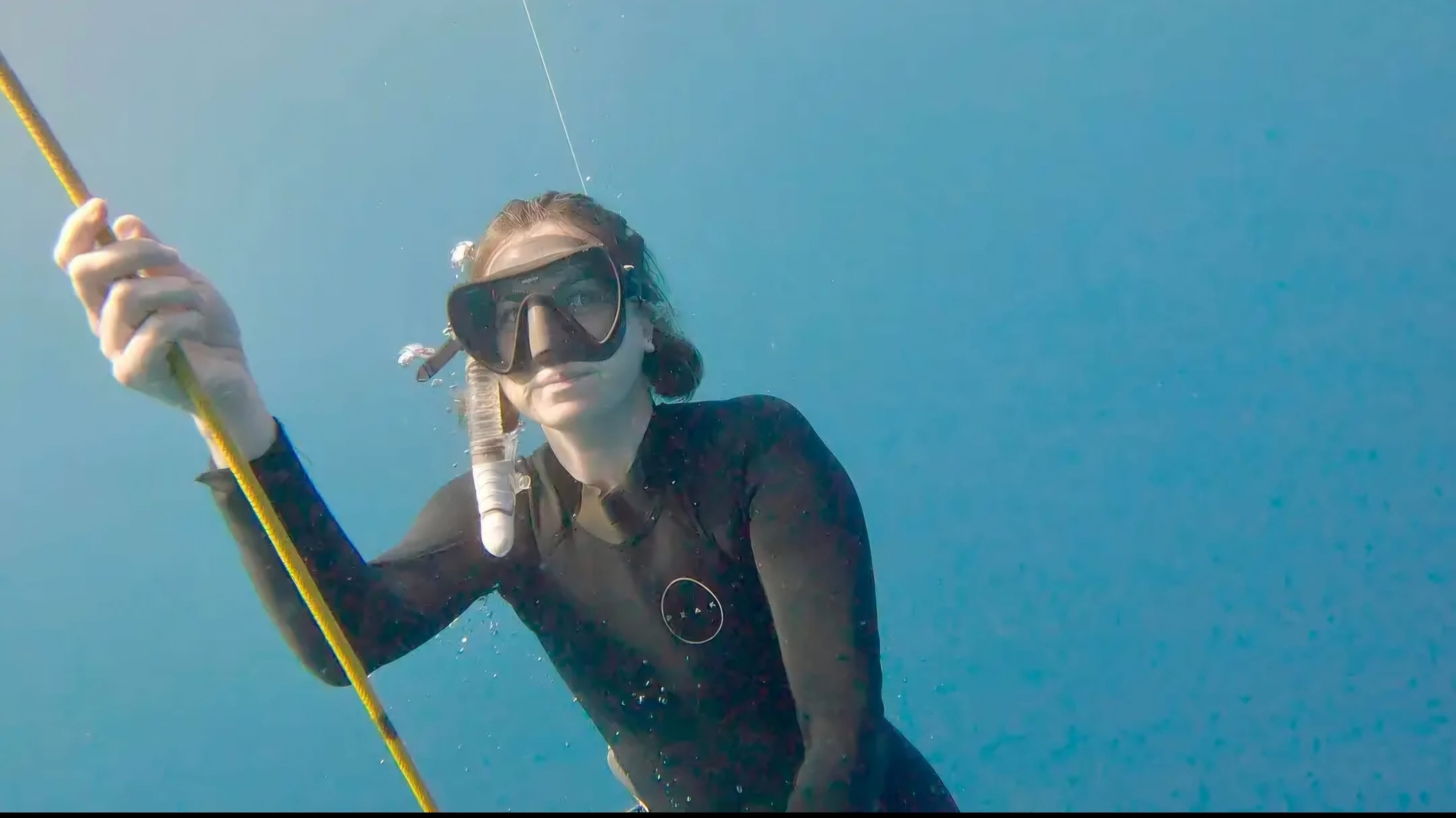
Two moons ago I was hanging off a dive line fifteen meters underwater in the Kimberley. I hung there on a breath hold curled over and clutching my heart as mothers and their babies sung around me. Vibrations of whale song ripping through the ocean fractals into the water of my body. The singing was so loud I could feel my chest and face hum. Every now and then I could hear the high pitch squeal of a new born. Their songs felt harrowing, they felt painfully alive, they felt like the first sounds to ever exist. I was surrounded by an underwater people who understood the path of movement and I wept at the belonging.
Later that evening I was camped in my swag by the fire and their sounds poured out of the ocean and across the sand. All night I lay awake listening to their songs as they were carried across the sand and ricocheted off the ancient cliffs. A sky full of galaxies and the air full of whale song.
I heard them sing of the great migration,
of endings and beginnings,
of the angst that is felt in the middle part of a migration both physically or internally. Those experiences where you are floating in the deep sea of transitions. The place where you meet creatures you never knew existed. Where you feel a little uneasy, unmoored.
Earlier this week my friends and I, we did big things. We held a two day truth telling process for twenty five strangers, one of hundreds that will pop up over Australia over the next six months. We spoke in the room of shame, of guilt, of loss, of horror, of genocide, of whiteness, of lostness and mostly of love. My fierce friends holding the colonial load poured onto them whilst they shared the stories of their lives, their loved ones, the whole resistance of their peoples to ongoing colonisation.
Upon reflecting, I think what has been pouring out of me as a facilitator and a participant in these processes is a necessary lament. Sometimes I can feel all the people that I have been a seed in, generations back, wrestling to wrap words around my tongue to partake in the lament needed in Australia. I love the closeness I feel to their wanting to join in and say, I am so sorry.
After day one of the workshop we went for a windy walk along the ocean front of Walyalup. The wind doctor had arrived and was blowing that hot salty wind that smells like octopus and simmering gum.
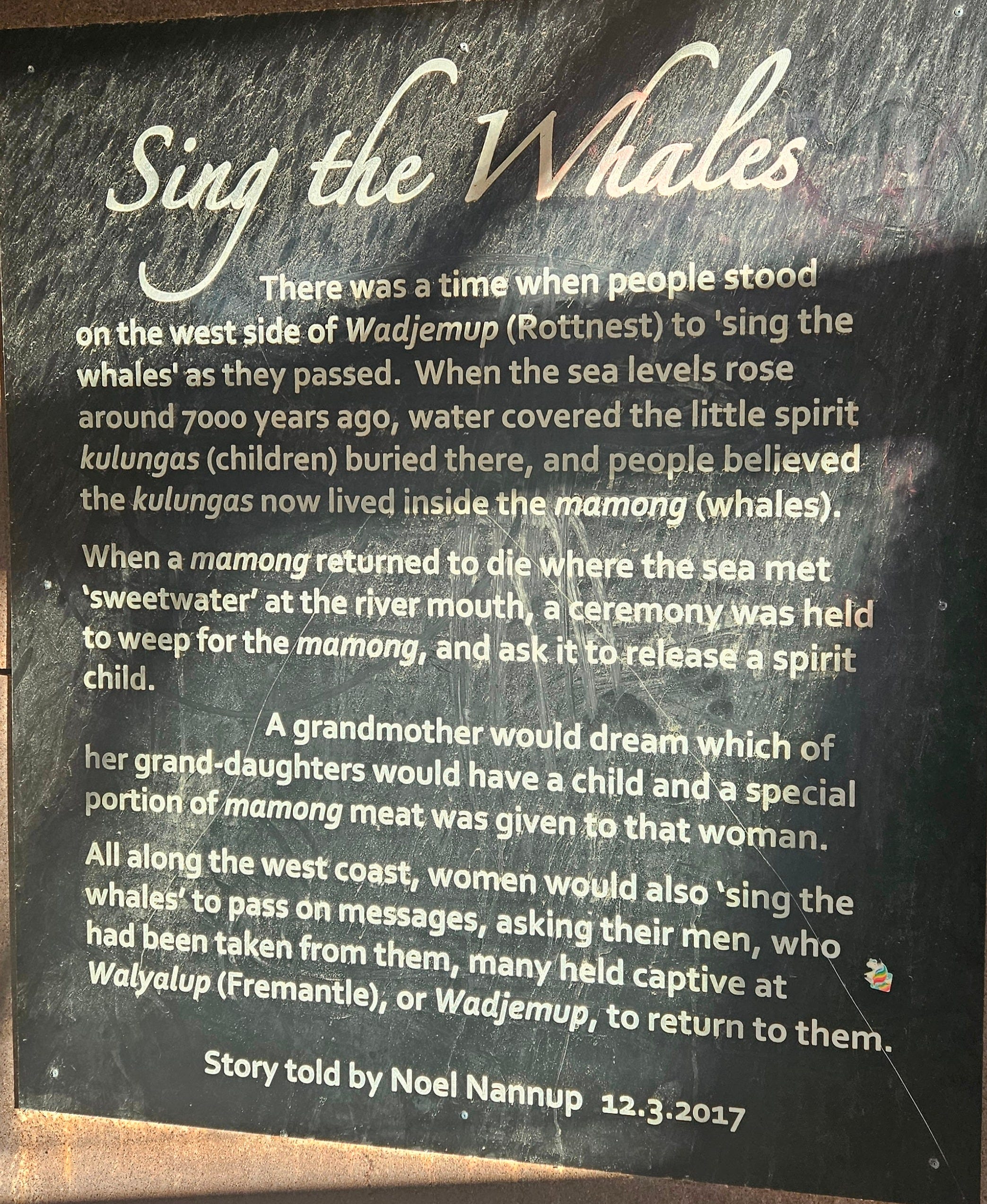
We walked toward the roundhouse of cells on the hill and underneath the roundhouse was a tunnel. The tunnel is a known massacre site for whales and as such, a massacre site for Noongar people, the two inseparable. As we stood at the opening of the tunnel, there were two engraved signs, facing each other on opposite sides of the gravel. The two worlds, facing each other. The Lament for the Whales & Sing for the Whales.
Take in the words of these two stories for a moment. The first written by Dr Noel Nannup a Nyungar Injabarndi elder, storyteller and cultural guide.
The second, titled a Lament for the Whales written through a settler lens is a factual account but leaves me wondering, is this a statement or a lament?
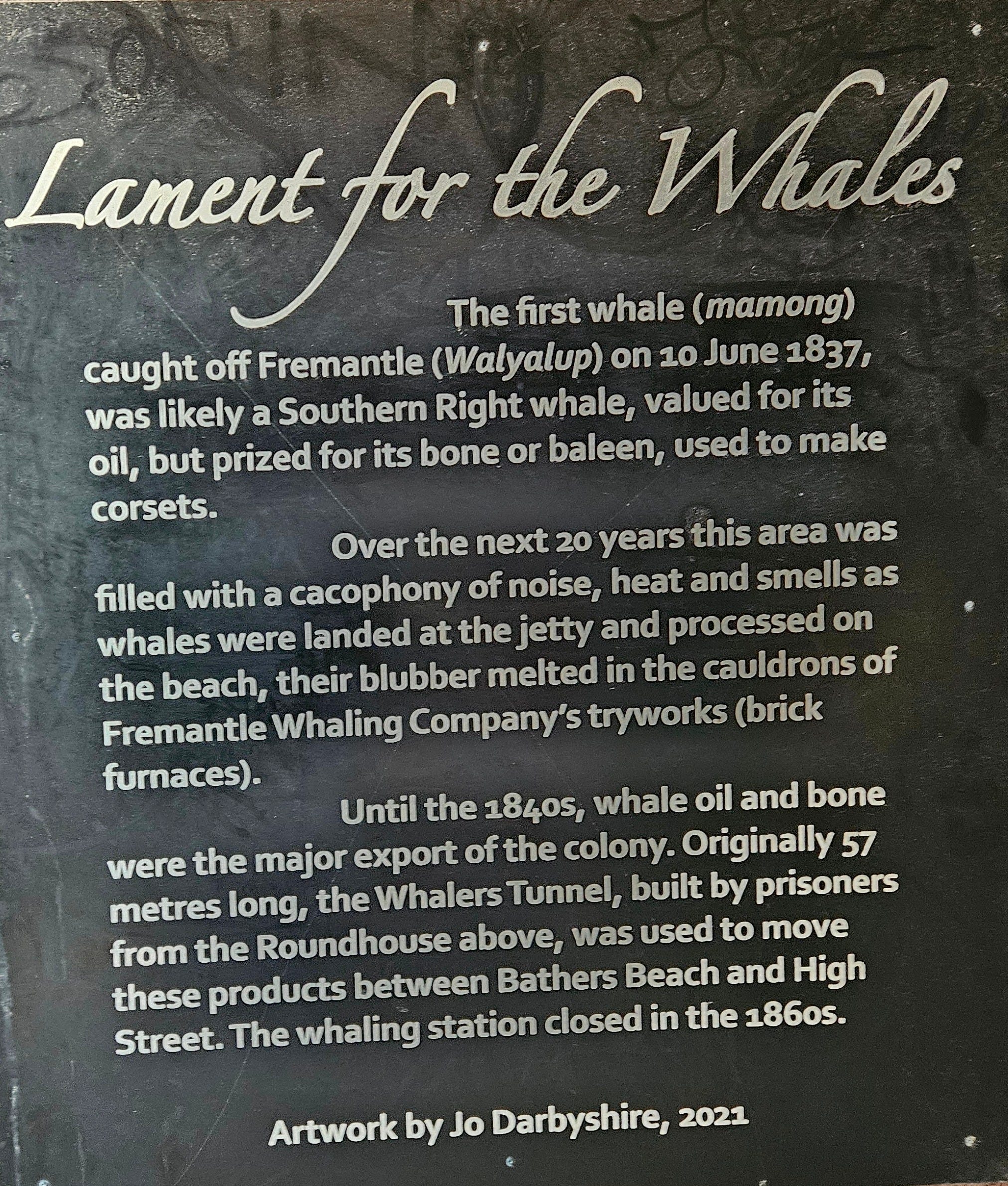
I want to take lament deeper than what is offered in this statement. We are in worrying territory for how we might heal our separation at our roots. We need a greater depth for how we might collectively grieve the past and the current horrors happening in the world.
To lament is to give something of yourself over to the sorrow, regret and pain that is felt. It requires a certain kind of making yourself small through expressing the truth that sits heavy on our hearts. Lament is a prayer, a song, a poem, an offering, an almighty howl.
Martin Shaw says that ‘statistics will not help us fall in love with anything, at this point. The hour is very, very late. And what we need is a great, powerful, tremulous falling back in love with our old, ancient, primordial Beloved, which is the Earth herself’.
The hour is indeed very, very late.
When I think about lamenting regret, sorrow and grief, I am reminded about all the times I finally get the courage to tell the truth. To stop pretending everything is okay, or that there isn’t a certain type of tension or ache in the air. Once it is named, the heart is set free to love ferociously again. I think lamenting and truth telling are interconnected.
For a tremulous falling back in love with our primordial beloved, we need a kind of lament that moves past fact telling and finds a home in truth telling.
These are very different energies.
One keeps us stuck and the other, dances us over the great rivers of loss and then carries us in gentle winds to new horizons.
Beautiful Anna. Feel like I just took a short migration with you. Thank you 🙏🏼
I love you and thank you for getting out of your way, because your words are going to shape minds forever ❤️